

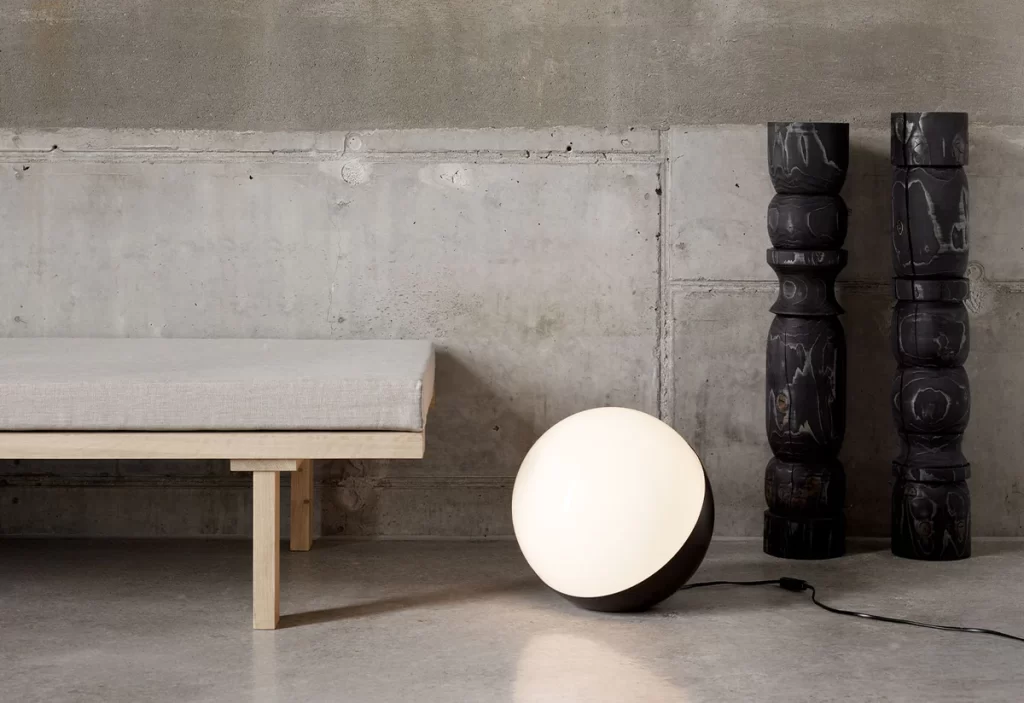
Vilhelm Lauritzen & Louis Poulsen: The Architecture of Light

In 1956, Danish architect Vilhelm Lauritzen conceived one of the most complete expressions of Scandinavian modernism: the Folkets Hus (House of the People) in Copenhagen.
The building was envisioned as a Gesamtkunstwerk, a total work of art in which every element, from the structure to the smallest fitting, was designed by Lauritzen himself.
Later transformed into the celebrated Vega Concert Hall, the project became an icon of Danish design through its holistic approach, where architecture, furniture, and light coexist in a continuous, harmonious dialogue.
Among Lauritzen’s original creations for the building were two pieces that would go on to define Nordic design: the Vega Chair, now reissued by Carl Hansen & Søn,, and the VL 56 Pendant Lamp, recently reintroduced by Louis Poulsen.
The chair, with its fluid lines and carefully balanced proportions, remains an example of poetic ergonomics, while the VL 56 embodies Lauritzen’s luminous philosophy, a piece that does not merely light a room but shapes space through silent elegance.
The concept behind the Folkets Hus was both simple and radical: a building designed as a unified body, where every door handle, staircase, socket, and lamp belonged to a
single architectural language.
Light was not an accessory, it was a structural material, as vital to the project as concrete or wood.

VL 56: The Lamp as Architecture
The VL 56 Pendant, designed specifically for the Folkets Hus, stands as a crystalline example of Lauritzen’s mastery in balancing function, proportion, and atmosphere.
Its conical metal form, paired with an internal white diffuser, reflects the technical rigour and formal purity of Danish modernist architecture.
Now produced once again by Louis Poulsen, the VL 56 retains its original precision while integrating subtle technical enhancements. Yet its essence remains untouched, a soft, directional light, perfectly balanced and profoundly human.
The VL 56 is more than a lamp; it is a synthesis of Lauritzen’s architectural thinking and Louis Poulsen’s lighting philosophy.
Both are grounded in the belief that light should serve space and human experience, rather than perform for aesthetic spectacle.
Even today, the VL 56 stands as one of the most refined and eloquent examples of how architecture can be translated into light.

Vega Pendant: The Circle as a Symbol of Harmony
Within the same building, Lauritzen also created the Vega Pendant, designed to illuminate the main hall of what would later become the Vega Concert Hall.
With its circular opal glass shade and lightweight metal structure, the pendant was conceived to float above the audience, casting a warm, even light that accentuates both
the material textures and the human scale of the space.
The Vega Pendant’s light is soft, glare-free, and deeply atmospheric, creating a feeling of closeness and serenity even within expansive interiors.
There is in it a kind of simplicity that only masters achieve: a pure form that feels inevitable, a presence that belongs naturally to the architecture.
But Lauritzen’s lamps did more than illuminate; they set the rhythm of the space. They followed the geometry, echoed the acoustics, and reinforced the harmony of the whole.
Lauritzen conceived light as though it were sound, something that reverberates through
the architecture, shaping the atmosphere with cadence and precision.
Each lamp became a note in an architectural symphony of form, material, and luminosity.

The Language of Detail
In Lauritzen’s collaboration with Louis Poulsen, every detail carried the same weight as the overall structure.
The aim was never to create decorative objects, but rather architectural instruments, objects that expressed the logic of the building and the intention of the space.
Each luminaire had to perform both under natural daylight and in the quietness of night, preserving its formal coherence and visual balance at all times.
Lauritzen understood that light shaped perception, and that its design was as essential as that of a wall, a window, or a doorframe.
This obsession with detail, with the invisible gesture, became the foundation of Louis Poulsen’s own philosophy: to use light as an invisible tool of design, centred on sensory experience and human comfort.
Lauritzen believed that good lighting should be almost imperceptible, felt rather than seen.
It marks the difference between comfort and discomfort, between presence and void.
That subtle mastery, the ability to make light disappear into space, remains the deepest legacy of his collaboration with Louis Poulsen.

Light and Modernity
The legacy of this partnership goes far beyond product design.
The relationship between Vilhelm Lauritzen and Louis Poulsen became a model for the dialogue between architecture and industry, reshaping how we think about the role of light in the built environment.
Lauritzen treated lighting as part of the spatial narrative, while Louis Poulsen saw in him a visionary who could interpret the company’s central mission: to give form to light.
The idea that light can serve as emotional structure, as essential to architecture as plan or volume, may be the most enduring lesson of their dialogue.
Even today, architects and designers draw upon this principle, creating spaces where light is not merely technical but expressive, capable of conjuring atmosphere and mood.
When a VL 56 or a Radiohus Pendant illuminates a contemporary interior, traces of that philosophy remain, a perfect harmony between functional precision and emotional resonance.
For Lauritzen, light was a natural extension of architecture, an invisible material capable of drawing volumes, softening concrete, and creating intimacy even in public space.
Louis Poulsen, in turn, recognised in Lauritzen a kindred spirit: someone who understood that true design lies not in the isolated form, but in the relationship between form, space, and light.
From the Folkets Hus to the Vega Concert Hall, from the VL 56 to the Vega Pendant, this collaboration left us not merely with luminaires, but with moments of perfect balance between technology and emotion.
Their light remains the invisible thread that binds architecture, design, and humanity, a timeless reminder that Scandinavian modernism does not age; it refines itself.
