
Architecture decides where we dine, where we read, where conversation lingers late into the night. The electrical installation, designed earlier and almost always in silence, decides where light can be. When the two do not coincide, it is light that gives way: the table moves closer to the socket, the lamp follows the cable, the terrace ends where the power supply ends.
It is a concession so old and so widely accepted that it is no longer noticed. And yet it shapes the way we live, with the same discretion with which a wall defines a route. The Panthella Portable, by Louis Poulsen, begins by calling that concession into question.
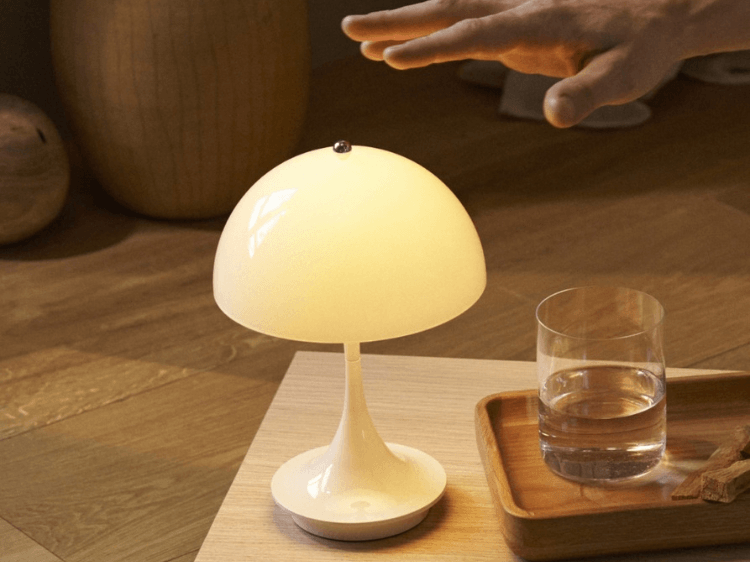
For most of domestic history, light was an object that was carried. The candle, the oil lamp, the lantern: they accompanied whoever moved from room to room, were set down wherever the task required, and were put out at the end of the evening. Light belonged to the person, not to the building.
Electrification reversed that relationship. We gained intensity, constancy and safety, and we lost mobility. Light became tied to the wall by a wire, and the house learned to organise itself around the points that wire could reach. It was a reasonable trade, made over decades with little discussion.
The rechargeable battery quietly restores a very old freedom. What distinguishes the Panthella Portable is the way it does so: without turning the lamp into a technological object, and without giving up the quality of light expected of a design piece.
The Panthella was designed in 1971 by Verner Panton, the Danish designer of the Panton Chair, the first chair made from a single piece of plastic. Panton is remembered for colour and form, but the Panthella reveals the less discussed side of his work: the optical rigour that lies beneath the organic silhouette.
Panton sought a lamp in which the stem and the shade would both work as reflectors. Light does not travel in a straight line to the eyes of those in the room: it is reflected, spread across the surface of the shade, and only then reaches the space. The result is soft, glare-free light, in which the form itself does the work that, in other lamps, falls to an added diffuser.
The curve of the stem, which flares like a trumpet to support a hemispherical shade, is not ornament. It is part of the optical system.
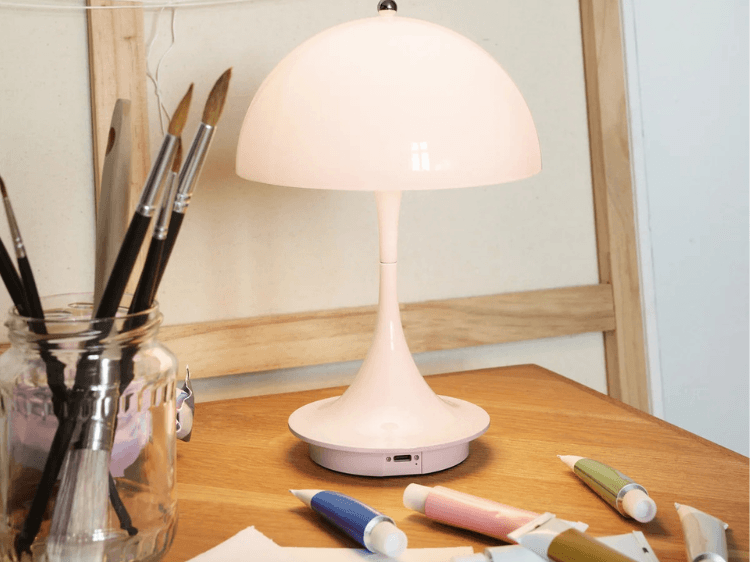
The portable version retains that geometry. It is a scaled-down version of the 1971 table lamp, designed to rest on a table, a shelf or a windowsill, and powered by a rechargeable battery instead of a cable. Nothing in the logic of the light has changed. Only the place where it can be has.
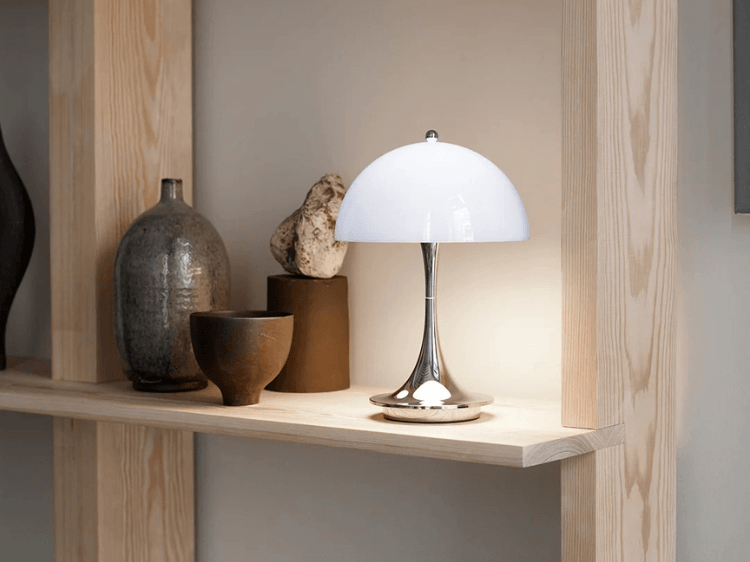
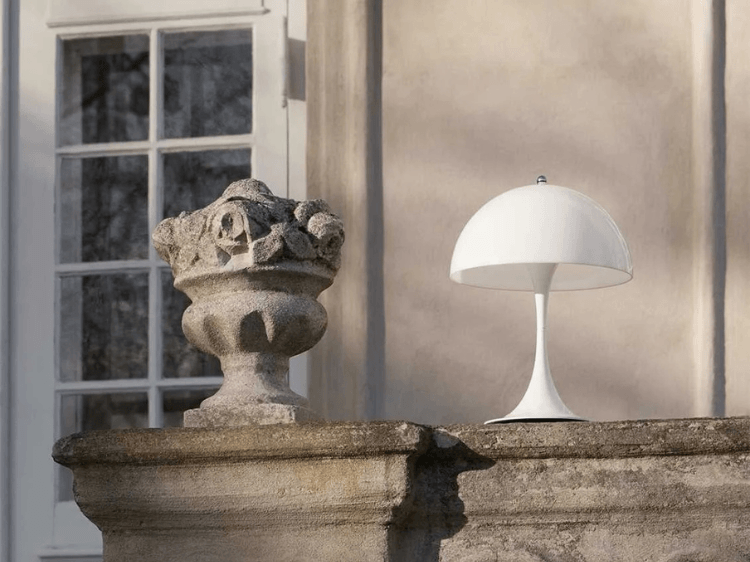
The first consequence concerns the plan. A dining table can stay where the architecture asks for it, not where the electrical layout allows, and move without anything having to be redone. The same applies to a shelf, a niche or a windowsill: places where accent light is desirable and a power supply was rarely planned.
The second concerns use. With an IP44 rating, the Panthella Portable is suitable for damp locations and follows life outdoors, onto a balcony or a covered terrace, with no cables crossing the floor. It is dimmed by touch, across three levels of intensity: the same piece serves dinner, reading and the end of the evening.
The third is of particular interest to those working in hospitality. Giving each table its own light, with no visible wiring or floor sockets, ceases to be a construction problem. It is recharged at the end of the day, like any other piece of service equipment.
There is also a less obvious consequence. Light that requires no intervention is reversible light. In rented homes, in buildings where the masonry cannot be touched, in temporary spaces or in projects that will change use, being able to add light without opening a wall is a real design advantage, not a detail.
Light used to stay where there was a socket. Now it stays where life happens.
The Panthella Portable is available with a translucent opal shade or an opaque shade, in acrylic or metal, and the choice changes how the light behaves.
Opal lets light pass through the material and glow, creating a diffuse, enveloping presence suited to shelves, bedrooms and living areas. The opaque shade directs light downwards and concentrates it on the surface beneath the lamp: a circle of light on the tabletop, ideal for a dining or reading table.
Both work with 2700 K LEDs, a warm colour temperature close to that of an incandescent bulb. The same form produces very different atmospheres, and the decision should start from what the space asks for: presence or focus.
Technical specifications for specifiers
|
Feature |
Panthella 160 Portable |
Panthella 250 Portable |
|
Design |
Verner Panton, 1971 |
Verner Panton, 1971 |
|
Charging |
USB-C |
USB-C |
|
Dimming |
Touch dimmer, stepped |
Touch dimmer, stepped |
|
Light source |
Integrated LED, 2700 K |
Integrated LED, 2700 K |
|
Protection |
IP44 |
IP44 |
|
Battery life |
Up to 8.5 h at 100% |
Approx. 5.5 h at 100%; up to 79 h at 10% |
|
Shade |
Opal or opaque, depending on finish |
Opal or opaque, depending on finish |
Battery life depends on the intensity level. At 10%, the Panthella 250 Portable reaches 79 hours, which, used only in the evening, translates into several weeks between charges. The battery of the 250 is replaceable, a discreet detail that weighs on the longevity of an object designed to last.
For architects and interior designers, the Panthella Portable solves a design problem without introducing an object that looks like a workaround. It is not a lamp with a battery. It is a lamp designed to reflect light that can now be carried with you.
This has practical value in specification. It makes it possible to respond to a lighting point the installation did not anticipate without redoing the installation, and to do so with a piece that belongs to the same design lineage as the other objects in the project, rather than an improvised accessory.
For those who live with it, the advantage is simple to describe and difficult to give up once experienced: light follows the day. From the dining table to the terrace, from the study to the bedside table, the same piece moves with the person.
It is a choice consistent with an idea that runs through the Louis Poulsen collection: the form of a lamp should derive from what the light needs to do. A 1971 design that remains in production proves, at the very least, that this idea ages well.
See the Panthella Portable at the Desenhabitado showroom in Lisbon, and experience how its light behaves in person.
Louis Poulsen Lisboa Schedule meeting